Frontier Research
Robotics
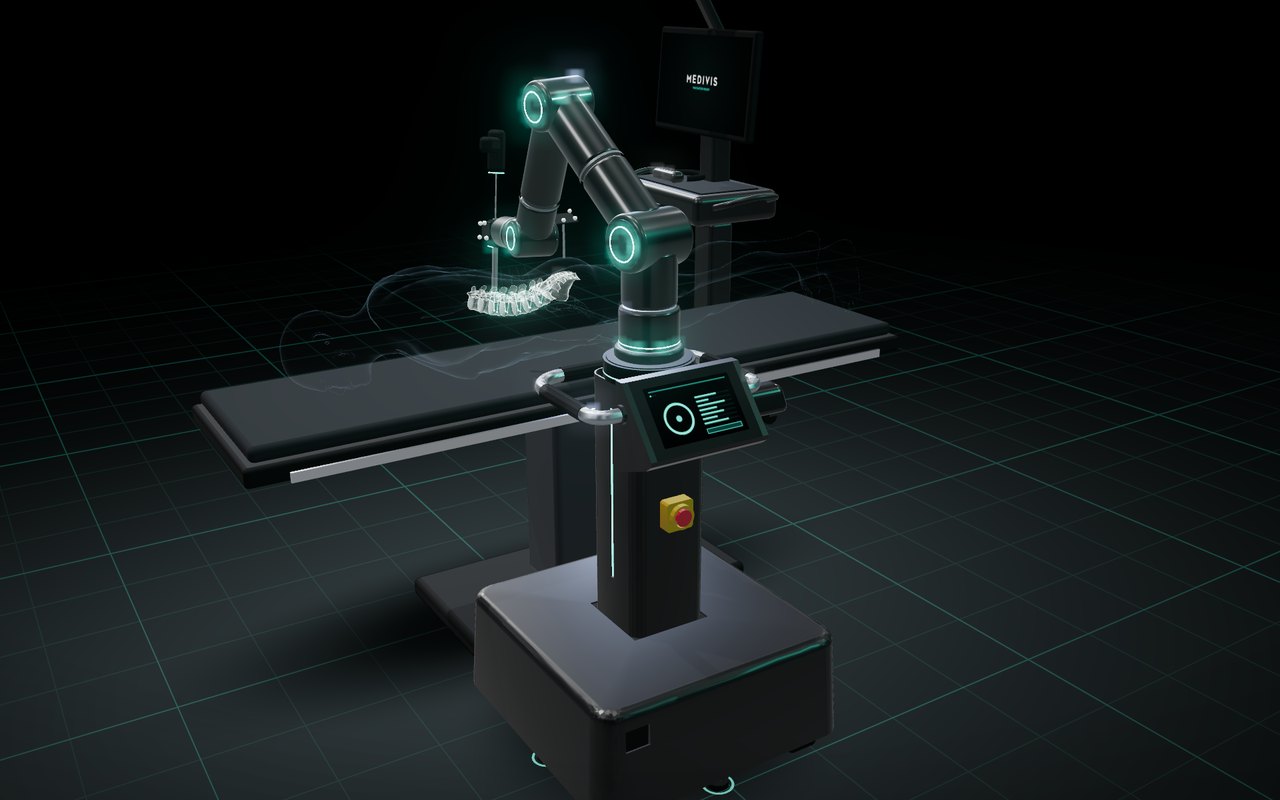
Robots that join a system which already knows where everything is. The plan, the patient and the tools are tracked; the robot drives to the plan the surgeon approved, then stops.
What it is
Navigation first. Then the arm.
Most surgical robots carry their own sense of where things are. Ours does not need to: it plugs into the same registration and tracking that Medivis Navigation already runs, so the robot inherits the plan, the anatomy and the instrument positions the surgeon is already looking at.
Autonomy, per skill
Six levels. Cleared robotics sits at 1. A few systems reach 2.
The field describes surgical robots on a 0 to 5 autonomy scale, deliberately modeled on the self-driving-car levels. It is the common language regulators use for how much the robot decides versus the surgeon. Most FDA-cleared surgical robots sit at Level 1 today. A few cleared systems reach Level 2 for a single planned task, such as preparing bone to a plan the surgeon approved. That is the bar the field has cleared. Everything above it is where the work is.
- 0 No autonomy
Who does whatThe robot executes the surgeon's direct motions in real time. Teleoperation.
Surgical exampleEvery motion is the surgeon's hand, scaled and filtered.
- 1 Robot assistance Most cleared robots today
Who does whatThe surgeon is in continuous control; the robot provides mechanical guidance or augmentation.
Surgical exampleTremor filtering, hands-on guiding, virtual fixtures (no-fly walls) while the human drives.
- 2 Task autonomy State of the art today
Who does whatThe surgeon specifies and approves a discrete task; the robot executes that one task on its own, then stops. The human picks the target and the moment.
Surgical exampleThe surgeon designates the trajectory; the robot drives the pedicle screw or the biopsy needle to it. Human in the loop per task.
- 3 Conditional autonomy
Who does whatThe robot generates the sequence and can run a chain of subtasks; the surgeon supervises closely and approves or intervenes.
Surgical exampleThe robot plans and executes a multi-step sequence, a full screw level (drill, tap, insert), while the surgeon monitors and can take over instantly.
- 4 High autonomy
Who does whatThe robot makes the intra-operative decisions and performs the procedure; a qualified surgeon supervises but is not hands-on.
Surgical exampleThe robot adapts the plan to what it sees mid-case; the surgeon watches, ready to abort.
- 5 Full autonomy No pathway today
Who does whatNo human needed. A robotic surgeon does the entire operation start to finish.
Surgical exampleDoes not exist. Aspirational; no regulatory pathway today.
The shortcut: 0 the robot is a puppet. 1 it helps your hand. 2 it does one task you approve. 3 it does a supervised sequence. 4 it decides, you watch. 5 it operates alone.
Scale: Yang G-Z et al., Medical robotics: regulatory, ethical, and legal considerations for increasing levels of autonomy. Science Robotics, 2017.
Frontier Robotics SimLab
Navigation closes the loop. Take the controls.
A browser simulation of a 7-DOF arm running inside the Medivis navigation loop, across spine, cranial and body. Step the robot up from Level 1 to Level 3 and watch tracking hold every move to the plan.
- Level 1 Robot assistance
- Level 2 Task autonomy
- Level 3 Conditional autonomy
Research simulation for exploring robotic guidance concepts. Not a medical device and not for clinical use. Patients and cases are synthetic.
 Play in your browser
 How it works
A loop that already knows where everything is.
01
One registration
The robot uses the same patient registration and instrument tracking as the navigation system. No second coordinate frame, no second setup.
02
Drive to the plan
The surgeon approves a trajectory from the plan. The arm positions the guide to it and holds. The surgeon does the work through the guide, or approves the next step.
03
A surgeon supervising, always
Every level we target keeps a surgeon in the loop, per task or per sequence, able to take over instantly. Autonomy climbs one skill at a time as fleet data proves it safe.
See where the research is heading.
Frontier programs start with a conversation. Tell us about your service line and the skill you would want a robot to hold, and a member of the team replies within one business day.
